





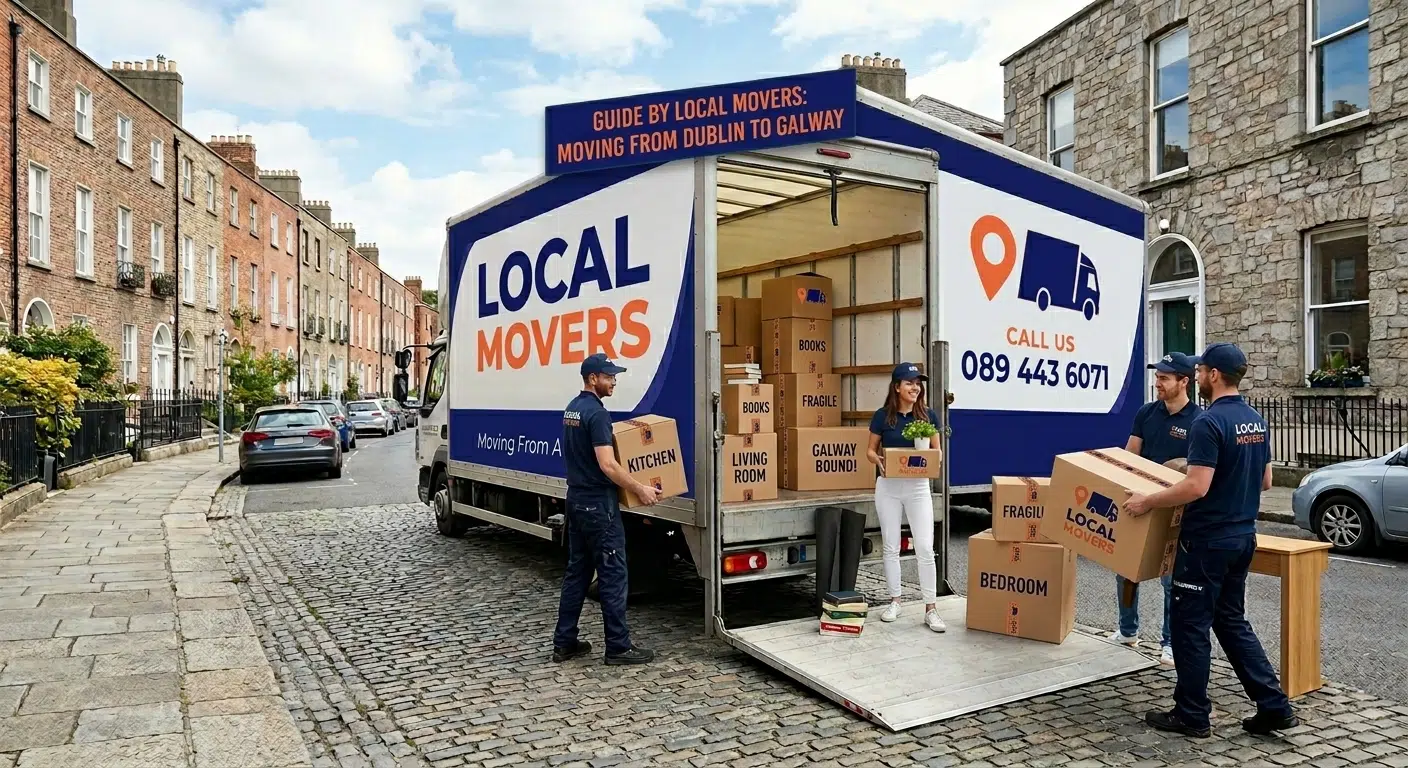
Moving from Dublin to Galway in 2026: Costs, Areas, Lifestyle and How to Plan the Move
At a glance: moving from Dublin to Galway
Moving from Dublin to Galway is one of the clearest “quality of life vs capital city” decisions in Ireland. You are trading a larger, more expensive city for a smaller, more compact one with strong culture, coastline and a different pace of life.
At a glance:
- You are looking at roughly 2–2.5 hours on the M6 between Dublin and Galway on move day.
- Housing is generally better value than comparable areas in Dublin, especially once you step outside the most in‑demand Galway spots.
- Daily commuting to Dublin is unrealistic for most people, but occasional trips work fine if you plan your week.
- The key choice is which part of Galway suits your work, family and lifestyle: city, suburbs, coastal villages or commuter towns.
- A properly planned move (with survey, packing and storage where needed) makes the Dublin‑to‑Galway route manageable in one or two days, depending on your property size.
This guide walks you through whether the move is right for you, where to live, what costs look like, the realities of leaving Dublin, and how Local Movers can help with the practical side of getting everything from A to B.
Is Moving from Dublin to Galway Right for You?
The first question is not “can I move to Galway?”, but “does Galway actually fit the life I want after Dublin?”.
It usually is the right move if:
- You are remote or hybrid and do not need to be in a Dublin office every day.
- You want shorter local journeys, a smaller city and easier access to the sea and outdoors.
- You are ready to swap some of Dublin’s convenience and variety for more space, value and a different pace.
- You can see yourself building a life in a city where community, culture and the coastline are part of the weekly routine.
It might not be the right move if:
- Your job is physically tied to Dublin five days a week.
- You rely heavily on Dublin’s specific industry cluster, nightlife or amenities and would miss them more than you gain in Galway.
- You are expecting Galway to be “Dublin with cheaper rent” instead of a fundamentally different city.
If you are already looking at Daft listings in Galway, checking school locations, calculating mortgage or rent differences and mentally picturing your life there, you are probably far enough along in the decision to benefit from planning the move properly.
Why people are moving from Dublin to Galway now
There are a few patterns that show up again and again when people talk about leaving Dublin for Galway:
- Housing pressure in Dublin: Even beyond the city centre, many buyers and renters feel stuck in small properties, high costs or long commutes, with only marginal improvements available by moving further along the commuter belt.
- Hybrid and remote work: More people can live where they want and only travel for occasional office days, meetings or events. Galway becomes viable instead of another Dublin suburb.
- Lifestyle reset: Galway’s cultural scene, festivals, pubs, restaurants, arts and live music are a major draw – but with a more manageable size and feel than Dublin.
- Access to coast and outdoors: Being minutes from the sea and within easy reach of Connemara and the wider west is a big reason for the move.
- Family and space: Many movers are at the “next stage” – trading an apartment or small house in Dublin for a family home or a better balance of space and cost.
For a lot of Dublin households, the decision comes after realising that upgrading within Dublin does not change their life enough to justify the cost. Upgrading to Galway, however, changes the entire setup.
Quick pros and cons of moving from Dublin to Galway
Quick pros
- Smaller, more manageable city with strong culture and character.
- Generally better value for housing compared with comparable Dublin areas.
- Shorter local journeys and the ability to live closer to the coast.
- Easier access to outdoor life: sea swimming, surfing, walking, hiking.
- Great fit for remote and hybrid workers who want “city plus lifestyle”.
Quick cons
- Far fewer job options than Dublin if you ever need to switch roles.
- Daily commuting to Dublin is too long for most people.
- Some Galway neighbourhoods have their own traffic pinch points.
- Rental supply can still be tight and competitive.
- You give up some of Dublin’s scale, diversity of amenities and anonymity.
Seeing the pros and cons clearly helps you sanity‑check whether you are moving towards something specific (the Galway life you want) rather than just moving away from Dublin frustration.
Who Galway suits best (and who it doesn’t) when you are leaving Dublin
Galway suits best if you:
- Work fully remote, hybrid, or in roles with strong Galway presence.
- Are happy to travel to Dublin only occasionally, not every day.
- Want a city that you can actually “know” and navigate without constant long commutes.
- Value coast, culture and community as part of your normal week.
- Are ready to be a little more intentional about work and career moves because you are no longer in the capital.
Galway may not suit if you:
- Depend on daily, in‑person access to Dublin’s job market.
- Want a “big city” feel with endless neighbourhoods and anonymity.
- Strongly prefer Dublin’s specific arts, nightlife or niche communities and do not want to trade them.
- Are not ready for the idea that shops, services and choice will be somewhat narrower than in Dublin.
Where to Live in Galway When You’re Moving from Dublin
Picking the right part of Galway is half the battle. For Dublin movers, some areas come up again and again.
Galway City Centre and immediate surrounds
Best for: people who want to walk everywhere, live in the middle of the action and stay close to work, food, culture and nightlife.
You will feel the difference versus Dublin straight away – the city is smaller, more walkable and easier to “get your head around”, but still busy and lively. It suits singles, couples and professionals who want to keep a city feel but are done with Dublin’s scale and rents.
The trade‑off: you may get less space than in the suburbs or commuter towns and you will pay a premium for very central, turnkey homes.
Salthill – coastal city living
Best for: people who dream of sea views, promenades and daily walks by the water, but still want fast access to the city.
Salthill is many Dublin movers’ first mental picture of “moving to Galway”: sea, cafés, restaurants, views and a clear sense of place. It is particularly attractive if you are remote or hybrid and want to start and end your day with the sea rather than traffic.
The trade‑off: competition for certain types of property, seasonal tourism feel, and the usual realities of coastal living (wind, weather, parking pressure at busy times).
Knocknacarra – family‑friendly suburb
Best for: families leaving Dublin who want a practical base: schools, amenities, accessible housing stock and proximity to the city without being directly in it.
Knocknacarra is the “real life” pick for many households: estates, services, schools and the kind of everyday convenience you need when you are juggling work, kids and activities. For Dublin movers, it often feels like getting the family setup they wanted without an M50 commute.
The trade‑off: you are in a suburb, not on the seafront or in the old city core. Your life will still involve driving at times, and you need to be mindful of traffic patterns and which side of the city you need to cross.
Oranmore – connected commuter town with value
Best for: people who want more space and value, good transport links and a town of its own.
Oranmore has become a popular option for movers who do not need to be in the city centre every day but still want straightforward access. It sits well for households that want to stretch their housing budget further while staying connected to Galway and the wider road network.
The trade‑off: you are not in Galway City itself, so some social and cultural life will mean trips in and out. You also become more car‑dependent, which may or may not bother you depending on your lifestyle.
Barna and other villages
Best for: movers who are primarily driven by lifestyle – scenery, village feel, community, and a quieter pace.
Areas like Barna appeal to Dublin movers who want the opposite of a capital: smaller, scenic and slower. They can be brilliant if you work remotely and build your social life locally, but they are most enjoyable if you genuinely like village life.
The trade‑off: more driving, fewer “big city” conveniences, and the need to plan outings a bit more than in Dublin.
Cost of Living and Housing: Dublin vs Galway
House prices and rents – what to expect
As a broad rule, you can usually get more for your money in Galway than in Dublin. That might mean:
- A similar budget gets you a larger house or better located property.
- Tight Dublin apartment budgets stretch further into Galway suburbs or commuter towns.
- You can sometimes trade a high Dublin rent for a Galway mortgage at a similar or lower monthly cost, depending on timing and interest rates.
But there are important nuances:
- Prime Galway areas (central, Salthill, certain coastal spots) still command a premium.
- The rental market can be competitive, with good properties going fast.
- Price differences are very specific to area and property type, so you need to compare like with like rather than just city averages.
Everyday costs: commuting, childcare and bills
Leaving Dublin can change your everyday spending in different ways:
- Commuting: If you currently pay to sit in traffic or commute long distances in Dublin, shorter local journeys in Galway city or suburbs can save time and money.
- Childcare: Availability and cost will still be a factor, but many families find things slightly less intense than in some Dublin hotspots.
- Transport: If you move somewhere walkable or cycle‑friendly, you may rely less on buses and long car journeys.
- Food and leisure: Day‑to‑day spending may feel similar, but what you do in your free time (sea, walks, local pubs) often changes the mix of costs.
The real financial question is usually: “Does this move give us a more sustainable monthly setup?” rather than just “Is the house cheaper?”
Buying vs renting when you first move
There are good arguments on both sides:
- Rent first if:
- You do not yet know which Galway area you really want.
- You are changing job and county at the same time and want flexibility.
- You want to test Salthill vs Knocknacarra vs Oranmore vs city centre in real life.
- Buy straight away if:
- You already know Galway well and have a clear area in mind.
- You are moving to a specific school catchment or community.
- You are moving with a long‑term view and have lined up your job or remote setup.
A hybrid approach some Dublin movers take is to rent short term while putting the bulk of their belongings into storage, then buy once they are sure about area and property type.
Travel and Commuting: Dublin vs Galway
Dublin to Galway on the day
For your actual move, you are looking at roughly 2–2.5 hours on the M6, plus loading and unloading time at either end. For many moves:
- A 1–2 bed apartment or small house can be done in one long day.
- A larger house or complex access can be one long day or split over two days, especially if packing and storage are involved.
- If you are using storage, collection and delivery may happen on different days.
Planning the move as a proper inter‑county job rather than a “big local move” is the key to avoiding stress.
Is commuting from Galway to Dublin realistic?
Technically, yes. Practically, it is draining for most people.
A daily Galway‑Dublin commute means several hours on the road, five days a week. Some people do it for short periods or specific contracts, but very few see it as a sustainable long‑term pattern. In reality:
- Galway works best when Dublin becomes a sometimes place, not your daily base.
- Occasional office days, client visits and events are fine with some planning.
- If you need to be in Dublin constantly, consider whether a full move makes sense yet.
Everyday Life in Galway (when you’re used to Dublin)
Schools and education
If you are moving with children, you will want to look closely at:
- School locations versus your chosen area (Knocknacarra, Oranmore, Barna, etc.).
- Enrolment timelines and waiting lists.
- How school runs will actually fit into your daily routes.
The good news is that Galway is compact enough that you are unlikely to face multi‑hour daily school commutes, but planning your area with schools in mind is still essential.
Amenities, shopping and eating out
Galway has:
- Supermarkets, local shops, markets and retail options.
- A strong food and pub scene, particularly in the city and Salthill.
- Enough services to handle most day‑to‑day needs without travelling far.
What changes versus Dublin is the range, not the availability. You will not have the same depth of niche options, but most households find they quickly build new favourites and routines that fit the city’s size.
Sport and outdoors – the big win
This is where Galway tends to shine for Dublin movers:
- Sea swimming, surfing and coastal walks on your doorstep or a short drive away.
- Easy access to walks, hikes and scenic drives in the wider county and nearby regions.
- Local clubs for GAA, soccer, rugby and many other sports.
If your free time is currently being eaten by commuting or city logistics, simply recovering those hours and putting them into something you actually enjoy is often the biggest quality‑of‑life upgrade.
Things People Forget When They Move from Dublin to Galway
Parking, estates and access
A few practical realities that can catch Dublin movers out:
- Some Galway estates and streets have tight parking, especially near the city and coast.
- Apartment moves still need clear access for a truck or van.
- If you are used to on‑street parking in Dublin, check how parking works in your new Galway area before move day.
Bins, broadband and other unglamorous essentials
Before you set a move date, make sure you have:
- Checked broadband availability and speeds in your chosen area, especially if you work remote.
- Looked into bin providers, collection schedules and any local restrictions.
- Understood local rules for residents’ permits, access gates or estate management.
These are boring details, but they matter disproportionately in the first few weeks in a new county.
Timing your move around schools and seasons
For Dublin‑to‑Galway moves, timing makes a big difference:
- Summer and school holidays are popular, but also peak moving season – book early.
- End of month sees more tenancies ending and starting – more competition for good slots.
- School terms: if you are moving with children, think hard about whether to move at the start of the summer or over a mid‑term break to ease the transition.
Using Storage When You’re Moving from Dublin to Galway
When storage actually helps with a Dublin–Galway move
Storage is not a luxury add‑on; it is often the thing that keeps the move sane. It is especially useful when:
- You are selling in Dublin before buying in Galway, and staying in temporary accommodation.
- You are downsizing and want time to decide what to keep.
- Your Galway property needs renovation or work before you move everything in.
- You are moving in stages – for example, one partner or some of the family moves first.
In all these cases, having your furniture and boxes in secure storage, under the same plan as your move, means you are not forced into rushed decisions or living in chaos.
How much storage space most Dublin‑to‑Galway movers need
As a rough guide (you can translate this into your own quoting logic):
- 1‑bed apartment: typically around a small unit or partial container.
- 2‑bed home: often one standard container or equivalent, depending on furniture.
- 3–4 bed home: multiple containers or a larger storage allocation, especially if there is a shed, attic or garage to factor in.
An actual survey or detailed video call is the best way to avoid over‑ or under‑estimating. Once you know your volume, you can decide whether to store everything or just the items that do not have an immediate place in the new Galway home.
How Local Movers coordinates moves and storage
The simplest setup is to put removals and storage under one plan:
- Your belongings are wrapped, loaded and inventoried once.
- The same team moves them into storage and later to your Galway address.
- You have one point of contact for dates, access and changes.
- You avoid paying for separate van hire and storage trips.
For a route like Dublin–Galway, that joined‑up approach matters, because delays, chain issues and renovation hold‑ups are common enough that flexibility is a real asset.
How Local Movers Helps People Move from Dublin to Galway
The moves we handle most often on this route
Local Movers regularly helps with:
- Dublin‑to‑Galway house moves (2–5 bed homes).
- Apartment moves from Dublin city and suburbs into Galway city, Salthill and suburbs.
- Families upsizing or downsizing between the two cities.
- Remote workers relocating from Dublin to Galway with office kit and home setups.
- Moves into temporary accommodation plus storage, followed by final delivery.
- Stage‑by‑stage moves where part of the household or contents moves first.
What working with Local Movers looks like (step by step)
- Enquiry and quick chat
You tell us about your move: property type, areas, dates, any special requirements. - Survey (in person or video)
We assess your volume, access and any packing or storage needs so we can quote properly. - Clear quote
You receive a quote covering removals, packing and storage options, so you can decide what level of service suits. - Booking and planning
Once you are happy, we lock in your dates, plan the route and confirm timings. - Packing (if included)
Our team can come out in advance or on the day to pack some or all of your belongings. - Move day – loading in Dublin
We protect floors where needed, wrap furniture, load the truck and confirm inventory. - Travel to Galway
Your belongings are transported securely along the Dublin–Galway route. - Delivery or storage
We either unload straight into your new Galway home, or move everything into storage until your property is ready. - Final placement and sign‑off
Furniture goes into the right rooms, boxes are placed where you want them, and we do a final walk‑through.
Why people trust us with Dublin–Galway moves
People tend to pick Local Movers for this route because:
- We treat it as a planned inter‑county move, not just a long local run.
- We can handle packing, transport and storage together.
- We are used to dealing with sale/purchase date changes and chain issues.
- We are clear about access, timing and expectations up front.
- Our crews are experienced with apartments, houses, coastal properties and rural access.
Frequently Asked Questions About Moving from Dublin to Galway
Is moving from Dublin to Galway worth it?
It is usually worth it for people who want a smaller city, better lifestyle balance and more value from their housing budget, and who can step away from daily Dublin commuting.
Which Galway areas are best for people moving from Dublin?
Salthill, Knocknacarra, Oranmore, Barna and Galway City Centre are common picks, depending on whether you want coast, family convenience, value, village feel or walkable city living.
What does a typical house move from Dublin to Galway cost?
Costs depend on your volume, access, packing level and whether storage is involved. Most moves are quoted as a fixed inter‑county price after a survey or detailed questionnaire rather than a simple hourly rate.
How far in advance should I book movers for a Dublin–Galway move?
Aim for at least 4–6 weeks, and more in peak months (summer, month‑end, school holidays). Earlier booking gives you better choice of dates and more time to plan around your buyer or landlord.
Should I rent first or buy straight away in Galway?
Rent first if you are not sure which area suits you best or if you are changing job and county together. Buy straight away if you already know the area, have lined up work and want to move once, not twice.
How long does a move from Dublin to Galway take on the day?
Many standard house moves can be done in one long day, but larger homes and complex access may be split over two days. Your plan will be set out clearly after your survey.
When should I think about using storage as part of the move?
As soon as there is a chance your dates will not line up, your new home needs work, or you are downsizing and do not want to rush decisions. Storage makes the whole move more flexible and less stressful.
Interested in moving elsewhere in Ireland?
Moving to Kildare in 2026: Areas, Costs, Commutes and How to Plan the Move
Why do Local Movers reviews praise professionalism and efficiency?
Can local moving companies handle large furniture disassembly and reassembly?
